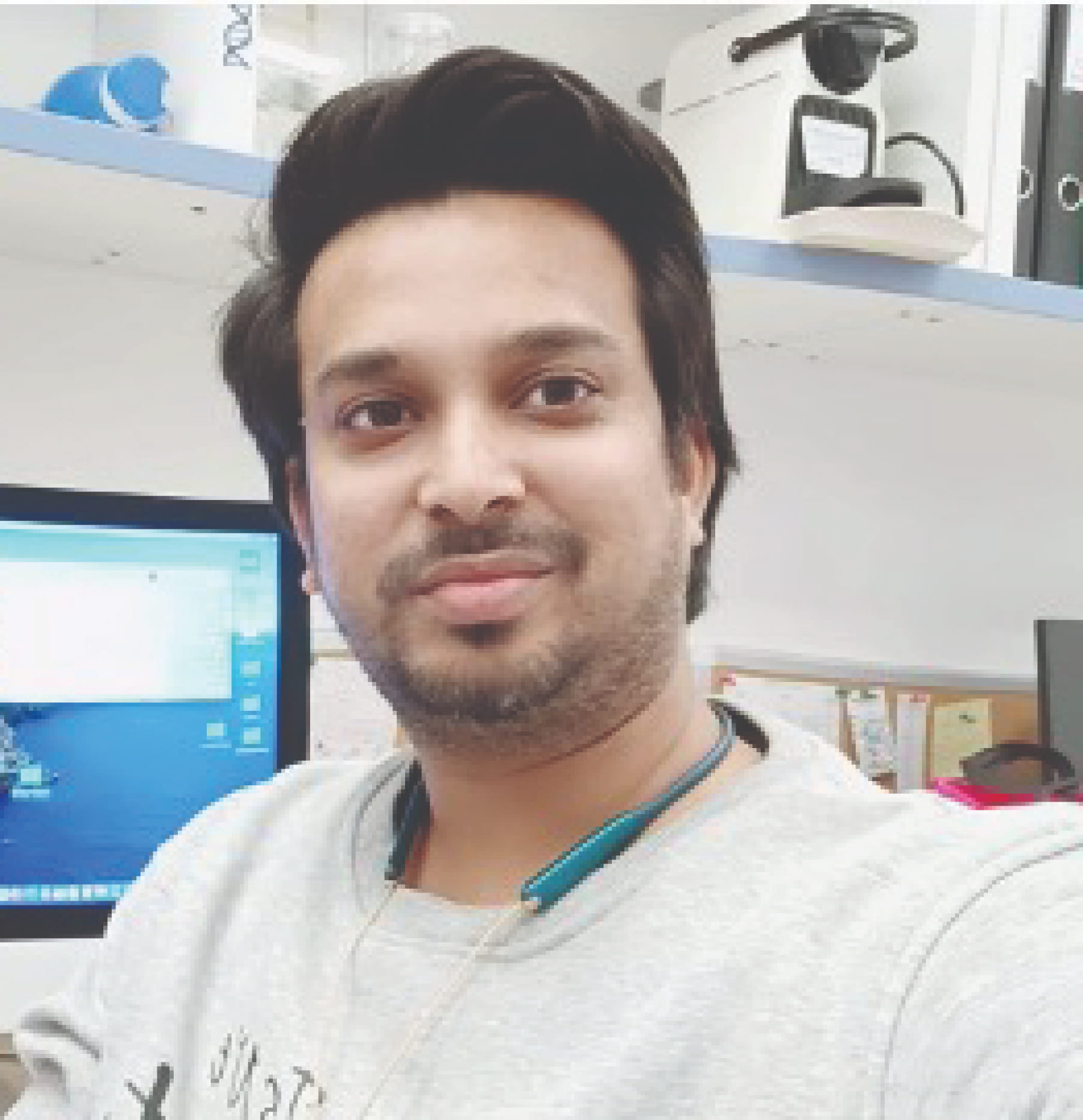
Dr. Rizwanul Haque
Assistant Professor
Division of Medical Research
Faculty of Medical & Health Sciences
SRM Institute of Science and Technology
Division of Medical Research
Faculty of Medical & Health Sciences
SRM Institute of Science and Technology
Qualification : Ph.D.
Email : rizwanuh@srmist.edu.in
Dr. Rizwanul Haque is a molecular neurobiologist specializing in sex-specific mechanisms of neurodegeneration and neuronal circuit formation. His research integrates genetics, transcriptomics, molecular biology, and behavioral neuroscience using Caenorhabditis elegans as a model system.
His work has uncovered conserved molecular pathways regulating sexual dimorphism in neural circuits and identified genetic modulators relevant to Alzheimer’s and Parkinson’s disease. With extensive international research experience in India, the USA, and Israel, he aims to translate mechanistic discoveries into sex-specific diagnostic and therapeutic strategies.
- Ph.D. (2012–2016) – Jawaharlal Nehru University
Research conducted at CSIR–CDRI, Lucknow, India - M.Sc. Biotechnology (2009–2011) – Aligarh Muslim University, Aligarh, India
- B.Sc. (Hons.) Biochemistry (2006–2009) – Aligarh Muslim University, Aligarh, India
- SRM Institute of Science and Technology (2025–Present)
Division of Medical Research, SRM Institute of Science and Technology, Chennai, India - Weizmann Institute of Science (2018–2025)
Department of Brain Sciences, Faculty of Biology, Weizmann Institute of Science Rehovot 76100, Israel - Biodesign Institute, Arizona State University (2016–2017)
Biodesign Institute Building A, 1001 S McAllister Ave, Tempe, AZ 85281, United States - Over 9+ years of international postdoctoral research experience in neurobiology, molecular genetics, and neurodegeneration.
- Neurodegenerative diseases (Alzheimer’s & Parkinson’s disease)
- Sex-specific neuronal circuits and sexual dimorphism
- Functional genomics and transcriptomics
- CRISPR gene editing and RNAi biology
- C. elegans disease modeling
Published research articles
- Haque, R., Setty, H., Lorenzo, R., Stelzer, G., Rotkopf, R., Salzberg, Y., Goldman, G., Kumar, S., Halber, S. N., Leifer, A. M., Schneidman, E., Laurent, P., & Oren-Suissa, M. (2025). Decoding sexual dimorphism of the sex-shared nervous system at single-neuron resolution. Science Advances, 11(28), 9106.
- Peedikayil-Kurien, S., Haque, R., Gat, A., and Oren-Suissa, M. (2025). Modulation by NPY/NPF-like receptor underlies experience-dependent, sexually dimorphic learning. Nature Communications, 16:1 16, 1–16.
- Haque, R., Peedikayil-Kurien, S., Setty, H., Salzberg, Y., Stelzer, G., Litvak, E., Gingold, H., Rechavi, O., and Oren-Suissa, M. (2024). Sex-Specific Developmental Gene Expression Atlas Unveils Dimorphic Gene Networks in elegans. Nature Communications, 15:1 15, 1–18.
- Haque, R., Shamsuzzama, Kumar, L., Sharma, T., Fatima, S., Jadiya, P., Siddiqi, M.I., and Nazir, A. (2020). Human insulin modulates α-synuclein aggregation via DAF-2/DAF-16 signalling pathway by antagonising DAF-2 receptor in elegans model of Parkinson’s disease. Oncotarget 11, 634–649. 10.18632/ONCOTARGET.27366.
- Kumar, L., Shamsuzzama, Jadiya, P., Haque, R., Shukla, S., and Nazir, A. (2018). Functional Characterization of Novel Circular RNA Molecule, circzip-2 and Its Synthesizing Gene zip-2 in elegans Model of Parkinson’s Disease. Mol Neurobiol 55, 6914–6926. 10.1007/S12035-018-0903-5.
- Haque, R., and Nazir, A. (2016). Identification and functional characterization of a putative IDE, C28F5.4 (ceIDE-1), in Caenorhabditis elegans: Implications for Alzheimer’s disease. Biochim Biophys Acta 1860, 2454–2462. 10.1016/J.BBAGEN.2016.07.013.
- Haque, R., and Nazir, A. (2016). SMAD Transcription Factor, Sma-9, Attunes TGF-β Signaling Cascade Towards Modulating Amyloid Beta Aggregation and Associated Outcome in Transgenic elegans. Mol Neurobiol 53, 109–119. 10.1007/S12035-014-8988-Y.
- Fatima, S., Haque, R., Jadiya, P., Shamsuzzama, Kumar, L., and Nazir, A. (2014). Ida-1, the Caenorhabditis elegans orthologue of mammalian diabetes autoantigen IA-2, potentially acts as a common modulator between Parkinson’s disease and Diabetes: role of Daf-2/Daf-16 insulin like signalling pathway. PLoS One 9. 10.1371/JOURNAL.PONE.0113986.
- Sashidhara, K. V., Modukuri, R.K., Jadiya, P., Dodda, R.P., Kumar, M., Sridhar, B., Kumar, V., Haque, R., Siddiqi, M.I., and Nazir, A. (2014). Benzofuran-chalcone hybrids as potential multifunctional agents against Alzheimer’s disease: synthesis and in vivo studies with transgenic Caenorhabditis elegans. ChemMedChem 9, 2671–2684. 10.1002/CMDC.201402291.
- Sashidhara, K. V., Modukuri, R.K., Jadiya, P., Rao, K.B., Sharma, T., Haque, R., Singh, D.K., Banerjee, D., Siddiqi, M.I., and Nazir, A. (2014). Discovery of 3-Arylcoumarin-tetracyclic Tacrine Hybrids as Multifunctional Agents against Parkinson’s Disease. ACS Med Chem Lett 5, 1099–1103. 10.1021/ML500222G.
- Haque, R., Anwar, S., and Younus, H. Effect of divalent cations on the activity and conformation of yeast alcohol dehydrogenase. (2012). Protein and Proteomics, 3(2) 113- 118.
Review articles
- Salzberg, Y., Haque, R., and Oren-Suissa, M. (2023). The synaptic basis for sexual dimorphism in the invertebrate nervous system. Curr Opin Neurobiol 82, 102757. 10.1016/J.CONB.2023.102757.
- Kumar, L., Shamsuzzama, Haque, R., Baghel, T., and Nazir, A. (2017). Circular RNAs: the Emerging Class of Non-coding RNAs and Their Potential Role in Human Neurodegenerative Diseases. Mol Neurobiol 54, 7224–7234. 10.1007/S12035-016-0213-8.
- Shamsuzzama, Kumar, L., Haque, R., and Nazir, A. (2016). Role of MicroRNA Let-7 in Modulating Multifactorial Aspect of Neurodegenerative Diseases: an Overview. Mol Neurobiol 53, 2787–2793. 10.1007/S12035-015-9145-Y.
- Haque, R., and Nazir, A. (2014). Insulin-degrading enzyme: a link between Alzheimer’s and type 2 diabetes mellitus. CNS Neurol Disord Drug Targets 13, 259–264. 10.2174/18715273113126660139.
Chapters in Books
- Haque, R., and Nazir, A. (2017). Advanced drug discovery for Alzheimer’s disease: Challenges and strategies. Drug Design: Principles and Applications, 9–29. 10.1007/978-981-10-5187-6_2/TABLES/2.
- Shamsuzzama, A., Kumar, L., Haque, R., and Nazir, A. (2018). Non-coding RNAs as potential targets for treatment and early diagnosis of age-associated neurodegenerative diseases. Molecular Basis and Emerging Strategies for Anti-aging Interventions, 19–33. 10.1007/978-981-13-1699-9_2/TABLES/2.
| S/No | Year of Passing | Awards and Achievements |
|---|---|---|
| 1 | 2019 | PBC fellowship for Outstanding Post-doctoral Researchers from China or India, Council for Higher Education, Government of Israel. |
| 2 | 2018 | Jamia Hamdard Post-doctoral - Silver Jubilee Fellowship (for 3 years), Jamia Hamdard University, India (Did not avail). |
| 3 | 2017 | Dr. JM Khanna Memorial Distinguished Career Achievement Award-2017 (Best Thesis Award) Pre-clinical & Clinical Sciences, Council of Scientific and Industrial Research -CDRI Lucknow, India. |
| 4 | 2016 | Best poster presentation in International symposium entitled “Current Trends in Drug Discovery & Research” organized by Council of Scientific and Industrial Research -CDRI Lucknow, India. |
| 5 | 2014 | First Prize for the best poster presentation in symposium entitled “Current Scenario in Drug Discovery & Development” organized by NIPER, Raebareli, India. |
| 6 | 2014 | Consolation Prize for the poster presentation in symposium entitled “Recent Advances in Free Radical Biology and Biochemistry” held at Department of Biochemistry, Aligarh Muslim University, India. |
| 7 | 2015 | International Travel Fellowship by following four bodies for attending the 20th International C. elegans meeting held between June 24-28, 2015 at the University of California, Los Angeles, USA.
|
| 8 | 2011 | Qualified National level scholarship test CSIR JRF (NET) UGC with All India Rank 59 of June 2011. |
| 9 | 2011 | Recipient of scholarship (Junior/Senior research fellowship) from University Grants Commission, India during Ph.D. program. |
| 10 | 2009 | Topper of Entrance test for M.Sc. (biotech), Aligarh Muslim University, India. |
| 11 | 2009 | Recipient of scholarship from Department of Biotechnology under the Ministry of Science and Technology, India during Master’s Degree program. |
| 12 | 2004 | Second Prize in Inter Branch Biology Olympiad (2004) held by City Montessori School, Lucknow, India. |